17 Best Things to Do in Ronda, Spain (2026 Guide)
 Bridge & gorgeCheck price
RondaandSetenil.com is reader-supported. When you book through our GetYourGuide links we may earn a commission, at no extra cost to you.
Historical amounts are approximate euro conversions using the ECB reference rate of 15 October 2026. They are not live quotes; check the tour for your date. ECB · 15/10/2026
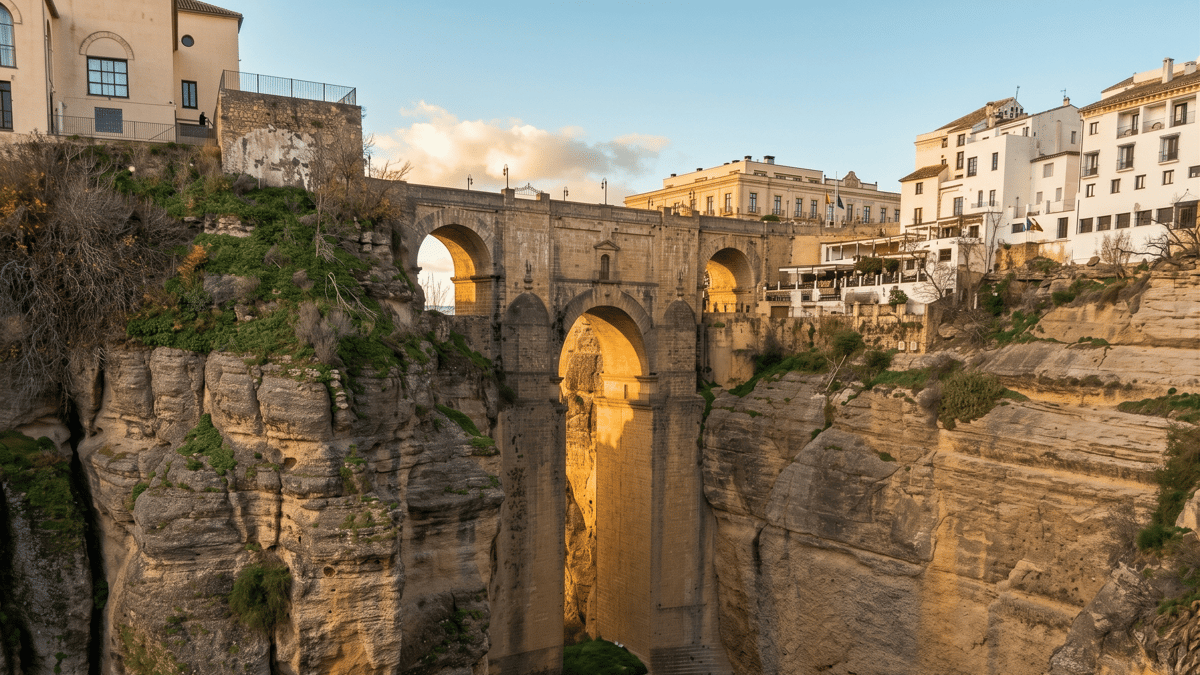
The best things to do in Ronda are concentrated in a compact area: stand on the 98 m Puente Nuevo, walk down into El Tajo gorge for the classic view from below, explore the old town’s Moorish baths and water mine, and watch the sun go down from the cliff-top Alameda del Tajo. Most of the 17 sights below sit within a 15-minute walk of the bridge, so even a 3-hour tour stop covers the highlights.
For each one you get what it is, why it is worth it, how long it takes and a practical tip. Opening hours and prices change by season, so treat any figure here as a guide and check before you go. If you are still choosing how to get here, start with our Ronda & Setenil day trip guide.
Ronda at a glance
- Where: Málaga province, ~730 m up in the Serranía de Ronda; ~1 h 35 by car from Málaga, ~1 h 45 from Seville.
- Layout: El Tajo gorge splits La Ciudad (the old Moorish town) from El Mercadillo (the 15th–18th-century “new” town, with the bullring and shops). Three bridges link them.
- Time needed: 3 hours for the essentials, a full day to add the gorge walkway and museums, an overnight for sunset and quiet streets.
The bridge and its viewpoints
1. Puente Nuevo
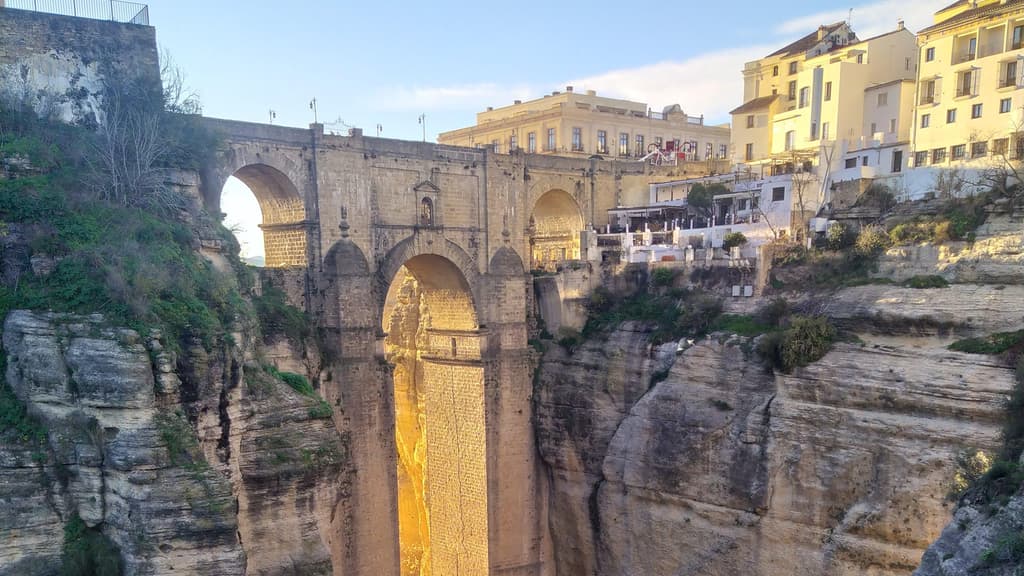
What: Ronda’s icon, a stone bridge 98 m above the Guadalevín river, built 1751–1793 to link La Ciudad and El Mercadillo. A small interpretation centre sits in the chamber above the central arch (once a prison cell).
Why go: It is the reason most people come – and crossing it, looking straight down into the gorge, still feels dramatic.
Time: 15 minutes on the bridge; 20–30 with the interpretation centre (small fee).
Tip: The bridge itself is not the best place to see the bridge. Use the viewpoints below for photos.
2. Mirador de Aldehuela
What: A small terrace on the old-town side, beside the Convento de Santo Domingo, named after José Martín de Aldehuela, the bridge’s architect.
Why go: Close-up views of the bridge face and down the gorge towards the Puente Viejo.
Time: 10 minutes.
Tip: It is the most crowded viewpoint in town – come before 10 am or after the tour coaches leave in the late afternoon.
3. Mirador de Ronda and the Alameda del Tajo (best for sunset)
What: The Alameda del Tajo is a shady 19th-century park next to the bullring; at its end the Mirador de Ronda balcony hangs over a sheer drop. The Paseo de los Ingleses and Paseo Blas Infante continue along the cliff edge towards the Parador.
Why go: Huge views west over the farmland and mountains – it is Ronda’s classic sunset spot.
Time: 20–30 minutes.
Tip: Other good sunset perches: the Puerta de Almocábar walls (No. 12) and the bottom-of-the-bridge viewpoint (No. 5), where the bridge glows in the evening light in spring and summer.
4. Jardines de Cuenca
What: Terraced gardens stepping down the Mercadillo side of the gorge between the Puente Nuevo and Puente Viejo, named after Ronda’s twin town of Cuenca.
Why go: Quiet, free and with the best angle on the Puente Viejo, plus a side view of the Puente Nuevo.
Time: 20 minutes.
Tip: Head for the lower terraces; light is best in the morning and early afternoon.
5. Walk down to the base of the bridge
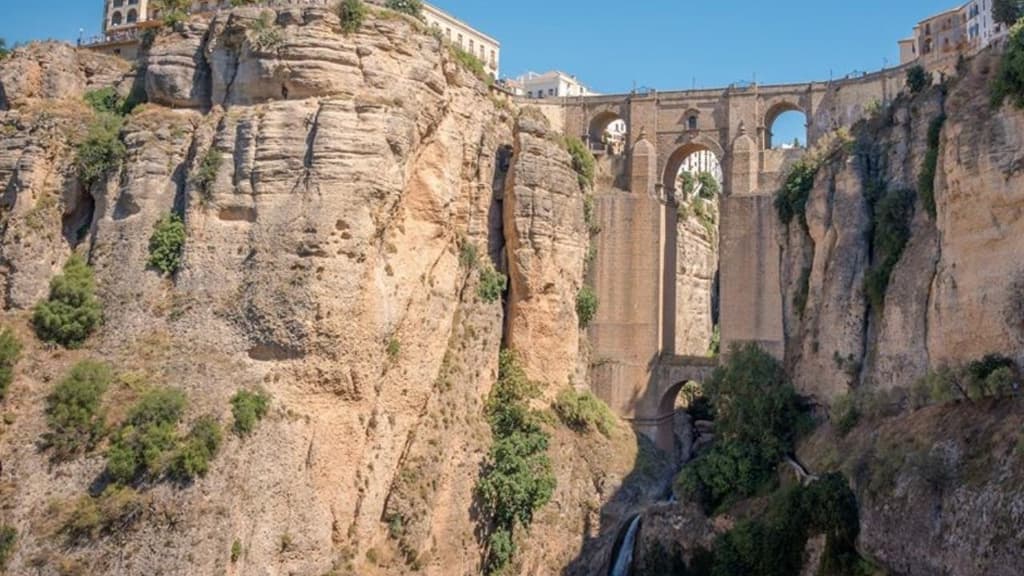
What: A free path from Plaza de María Auxiliadora (old-town side) zigzags down the cliff to the ruined Arco Árabe and a viewpoint facing the full height of the Puente Nuevo – the “postcard” shot.
Why go: Only from below do you grasp the bridge’s scale.
Time: About 1 hour round trip including photos.
Tip: It is steep, rough and unshaded; wear proper shoes and carry water in summer. The climb back is the hard part.
 Bridge & gorgeCheck price
6. Camino del Desfiladero del Tajo (gorge walkway)
What: A wooden walkway through the bottom of the gorge, designed by Luis Machuca (architect of the Caminito del Rey). The first ~200 m section opened in April 2024; the second phase, a further ~500 m along the Guadalevín, opened on 16 September 2026. The full route runs from Plaza de María Auxiliadora, under the Puente Nuevo and past the Casa del Rey Moro water mine, to the Padre Jesús quarter near the Arab Baths.
Why go: For the first time you can walk beneath the Puente Nuevo along the river – the newest thing to do in Ronda.
Time: About 20–30 minutes one way, plus the walk back up through town.
Tip: Launch reports give €12 for visitors (free for Ronda residents), a compulsory helmet, limited numbers on the walkway and a minimum age; book a slot on the official site, desfiladerodeltajo.info. Hours were not published at launch – check before you go.
Bridges, baths and Moorish Ronda
7. Puente Viejo and Puente Árabe
What: Ronda’s two older bridges, downstream of the Puente Nuevo. The Puente Viejo dates from 1616; just below it, the low Puente Árabe (also called Puente Romano or de San Miguel) is the oldest crossing, near the Arab Baths. The Arco de Felipe V gate stands beside the Puente Viejo.
Why go: A pretty, much quieter walk – and the natural route to the baths.
Time: 30 minutes as a loop from the Puente Nuevo.
Tip: Walk down via Jardines de Cuenca, cross the Puente Viejo, visit the baths and climb back into La Ciudad past the Casa del Rey Moro.
8. Baños Árabes
What: 13th–14th-century Moorish bathhouse in the old Padre Jesús quarter, often called the best preserved in Spain, with star-shaped skylights in brick vaults.
Why go: Atmospheric, cool on a hot day and genuinely old.
Time: 30 minutes.
Tip: Hours vary by season and include early closing on some days – check the turismoderonda.es page. Entry is a few euros.
9. Casa del Rey Moro and La Mina
What: Despite the name, the house is not Moorish and is not open; you visit its hanging gardens (laid out by French landscape architect Jean-Claude Forestier in 1912) and the 14th-century water mine – a stairway of close to 300 steps cut through the rock to the river.
Why go: Descending the damp, dark staircase to a platform at the bottom of the gorge is one of Ronda’s most memorable experiences.
Time: 45–60 minutes.
Tip: The climb back up is steep – skip La Mina if you have bad knees and enjoy the gardens and café instead. Recent guides quote around €7–10; check at the gate.
10. Palacio de Mondragón
What: A palace of Moorish origin, remodelled after the 1485 Christian conquest, now the Municipal Museum (archaeology and the Serranía’s history).
Why go: The Mudéjar courtyards and cliff-edge garden are lovely; the museum suits history fans.
Time: 30–45 minutes.
Tip: Ask whether a combined ticket with other municipal monuments is available that day.
11. Iglesia de Santa María la Mayor
What: Ronda’s main church, on Plaza Duquesa de Parcent, built over the town’s main mosque – a mihrab arch survives – with Gothic, Renaissance and Baroque parts.
Why go: The mix of styles tells Ronda’s history in one building, and the upper gallery has rooftop views.
Time: 30 minutes.
Tip: Entry is around €4–4.50 at recent prices; Sunday mornings have restricted visiting hours for services.
12. Murallas and Puerta de Almocábar
What: The southern walls of La Ciudad and the 13th-century Puerta de Almocábar, the main gate of Moorish Ronda; its name comes from al-maqabir (the cemetery) that lay outside.
Why go: Few tour groups get this far, and the walk along the eastern walls gives wide countryside views.
Time: 30–45 minutes.
Tip: Pair it with the Barrio de San Francisco just outside the gate.
Bullring, streets and food
13. Plaza de Toros and museum
What: One of Spain’s oldest bullrings, inaugurated in 1785 and built entirely in stone, with a museum of bullfighting history and antique weapons.
Why go: Walking onto the sand of the arena and under the double-tiered arcades is impressive even if you dislike bullfighting.
Time: 45 minutes.
Tip: The official site (rmcr.org) lists daily opening, 10 am to 6, 7 or 8 pm depending on season, and €9 general entry or €10.50 with audio guide (Oct 2026). Consolidation works were under way, so check for partial closures.
14. Calle de la Bola and tapas
What: Carrera Espinel, known to everyone as Calle de la Bola, is El Mercadillo’s long pedestrian shopping street, running from near the bullring.
Why go: The streets either side hold some of Ronda’s best-value tapas bars, usually cheaper than terraces facing the bridge.
Time: 30–60 minutes.
Tip: Try rabo de toro (oxtail stew), local cheeses and Ronda wine; Spanish lunch runs from about 1.30 pm.
15. Wine tasting in the Serranía de Ronda
What: The hills around Ronda form the Serranía de Ronda subzone of the DO Sierras de Málaga, with more than a dozen small wineries. Several open by appointment, such as Descalzos Viejos (in a restored 16th-century convent on the edge of town) and Bodega Lunares off the A-366.
Why go: High-altitude reds and whites you rarely see outside Andalusia, in beautiful countryside.
Time: 1.5–3 hours per visit.
Tip: Most require advance booking; several Málaga tours include an optional tasting in Ronda if you are not driving.
 Bridge & gorgeCheck price
Day trips from Ronda
16. Cueva de la Pileta
What: A cave near Benaoján, roughly 25 km south-west of Ronda, with Palaeolithic paintings of horses, deer and fish thought to be roughly 25,000 years old. Discovered in 1905 and still run by the family who found it.
Why go: You visit by the light of hand-held lamps in small guided groups – a rare, unvarnished experience.
Time: About 1–1.5 hours on site plus the drive.
Tip: Visits are guided only, numbers are limited and booking ahead is strongly advised; tours are usually in Spanish. No photography, and wear grippy shoes.
17. Setenil de las Bodegas
What: The village where houses are built under huge overhanging rocks, 18–20 km (about 20 minutes) north of Ronda.
Why go: It is the perfect counterpoint to Ronda and needs only 1–2 hours. See things to do in Setenil de las Bodegas.
Tip: Without a car, a half-day trip from Ronda with the Setenil tourist train costs from about €16.95 (Oct 2026); local buses are few. For more villages, see our white villages near Ronda guide.
Ronda in 3 hours: a mini-itinerary for tour visitors
Most day trips give you 2–3 hours in Ronda. This loop fits that window if you keep moving:
- 0:00 – Plaza de Toros (outside) and Alameda del Tajo. Coaches usually drop near the bullring. Walk to the Mirador de Ronda balcony (10 min).
- 0:15 – Puente Nuevo. Cross the bridge, then step into the Mirador de Aldehuela (15 min).
- 0:30 – Down to the bridge base. From Plaza de María Auxiliadora, walk to the Arco Árabe viewpoint and back (45–60 min). Alternative: the Desfiladero walkway if you have pre-booked a slot.
- 1:30 – Old town stroll. Santa María la Mayor’s square, Palacio de Mondragón’s exterior and Casa del Rey Moro’s entrance (30 min). Add La Mina only if you skipped step 3.
- 2:00 – Lunch or tapas in the streets off Calle de la Bola (45 min), then back to the coach.
Short on time? Skip the walk down and visit the bullring museum or Arab Baths instead. Want a guide to do the navigating? The guided Ronda & Setenil tour from Málaga includes a walking tour (from about €58.89, Oct 2026; prices change). Compare more in guided vs free-time Ronda tours.
Practical tips
- Beat the crowds: coaches arrive from about 10.30–11 am and leave by late afternoon. Early mornings and evenings are calm – a strong argument for staying overnight in Ronda.
- Weather: at ~730 m Ronda is cooler than the coast – highs around 11 °C in January but 29 °C in July and August. See the best time to visit.
- Parking: use the underground car parks at Plaza del Socorro or Martínez Astein rather than driving into the old town.
- Footwear: almost every gorge view involves steep, uneven paths.
FAQs
See the Puente Nuevo from below. Walk down from Plaza de María Auxiliadora to the Arco Árabe viewpoint, or book the new Desfiladero del Tajo walkway that passes beneath the bridge. Yes for the highlights: the bridge, two viewpoints, a walk into the old town and a quick lunch. You will not have time for museums, La Mina and the walk to the bridge base all together. Yes. Since September 2026 the Camino del Desfiladero del Tajo walkway runs through the gorge beneath the bridge to the Arab Baths. It is ticketed (reported at €12) with timed entry; check desfiladerodeltajo.info. Yes if you can manage close to 300 steep steps down and back up. The water mine leads to the bottom of the gorge; the gardens alone are pleasant but less special. The Mirador de Ronda at the end of the Alameda del Tajo, looking west over the countryside. The viewpoint below the Puente Nuevo is also excellent when the bridge catches the evening sun.What is the number one thing to do in Ronda?
Is 3 hours enough in Ronda?
Can you walk under the Puente Nuevo?
Is the Casa del Rey Moro worth it?
Where is the best place to watch the sunset in Ronda?
More questions answered
FAQ · 6 min read
Ronda Day Trip: From Málaga or From Seville?
Ronda day trip from Málaga or Seville? Compare drive times, scenic routes, tour prices (€40.15 vs €94.58 median), buses and extra stops to pick the best base.
Read the answers →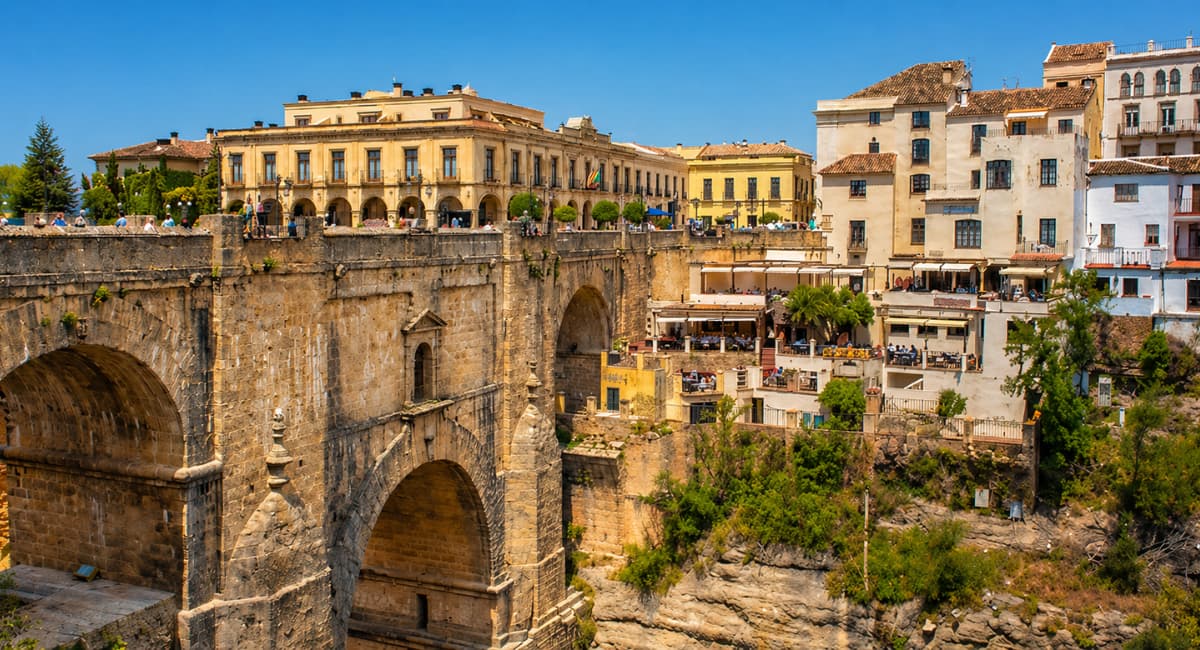
FAQ · 10 min read
Ronda and Setenil de las Bodegas Day Trip: The Complete Guide
Plan a Ronda and Setenil de las Bodegas day trip: how to get there, tour vs car, a sample itinerary, what to see, best time to visit and real costs.
Read the answers →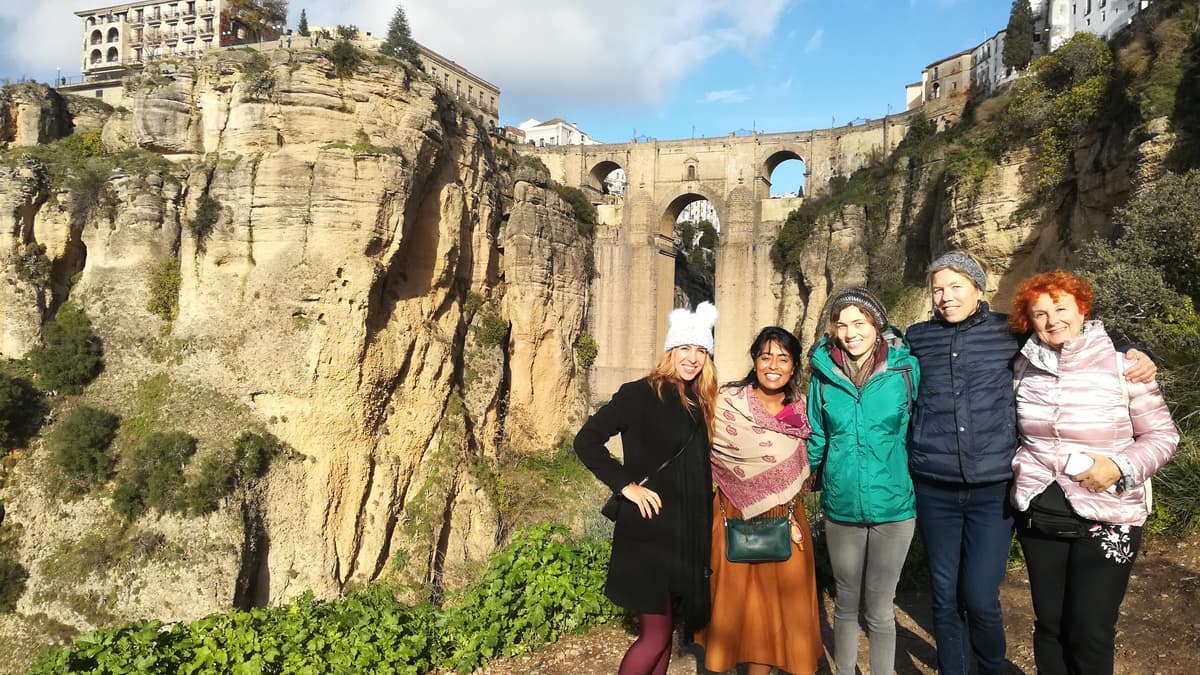
FAQ · 6 min read
Ronda & Setenil from Seville: Tours, Routes & Bus
Visit Ronda and Setenil from Seville: tours from about €49.07, three driving routes via Olvera, Zahara and Grazalema, plus bus and train options.
Read the answers →